
The Arcep Body responsible for settling disputes, legal proceedings and investigations (RDPI Body) has ruled on the requests submitted by the firm Hub One as part of a dispute over the technical and financial conditions governing access to the civil engineering infrastructures belonging to urban property association (Association foncière urbaine) Paris Nord 2 (hereafter “AFU”).
On 14 May 2024, AFU, the manager of the civil engineering infrastructures located in the Paris Nord 2 business park, notified Hub One of the cancellation, with one year’s notice, of a framework agreement signed on 20 May 2022, and the associated application agreements whereby Hub One is authorised to access AFU infrastructures. This cancellation is attached to a request for the laying on 15 May 2025 of optical fibre cables pulled by Hub One since 1 January 2022, and street cabinets installed by Hub One on AFU property in 2017 and 2018. On 12 February 2025, AFU sent to Hub One a draft framework agreement for accessing its hosting infrastructures, over which the parties were unable to reach an agreement.
As a reminder, having received a request for provisional measures, the Authority ordered the optical fibre cables that had already been deployed in AFU civil engineering infrastructures, as well as the street cabinets installed on AFU property, to be maintained until the decision on the merits[1] was issued.
The Authority settled the dispute on the merits in a Decision being published today.
The Authority granted the Hub One request that AFU submit a draft framework agreement, as well as some of the requests for changes to the clauses of the draft agreement negotiated by the parties
First, the Authority concluded that it fell within its remit and deemed reasonable and justified the Hub One request that AFU submit a new draft framework agreement, based on the draft already exchanged between the parties, setting the arrangements governing access to its civil engineering infrastructures in application of Article L. 34-8-2-1 of the French Postal and Electronic Communications Code (CPCE).
Within this context, the Authority partially granted the Hub One request that some of clauses in the draft agreement be amended. In particular, it ordered the removal of the clauses imposing a cable pulling procedure on Hub One, and increasing the fees which are different from the ones planned for other operators in the business park, in those instances where this different treatment is not justified.
The Authority did not, however, grant the Hub One request to maintain previous access agreements, given the infrastructure manager’s right to amend the contractual framework governing the provision of its hosting infrastructures. It nevertheless specified that this right must not undermine either the economic balance of existing contracts, nor the maintenance of existing cables (with the exception of refusals made under the conditions set forth in CPCE Article L. 34-8-2-1).
Moreover, the Authority ordered AFU to adjust the rules for implementing the pricing mechanism it put in place to incentivise operators to optimise the use of its infrastructures, in particular to ensure that it does not create a distortion in competition between operators.
In addition, the Authority rejected as inadmissible certain Hub One requests, notably the request for the application of fair, reasonable and non-discriminatory prices for accessing civil engineering infrastructures, as the Authority considered them abstract or not sufficiently precise.
Second, the Authority rejected the Hub One request to maintain street cabinets while ordering AFU to propose an access solution that would enable Hub One to ensure the operation and maintenance of its network.
The Authority concluded, first, that it was competent to rule on the request to maintain the street cabinets already installed by Hub One on AFU property as, given the physical and functional ties they have with the hosting infrastructure, they can be viewed as accessory to that infrastructure.
The Authority then noted that the demand for effective access implies that the draft framework agreement provides Hub One with a solution that enables it to ensure the maintenance and continuity of the electronic communications services it provides to its customers. It nevertheless concluded that the request concerning the maintenance of street cabinets was not warranted in this case.
In particular, The Authority concluded that Hub One had not demonstrated that the alternative solutions that AFU offered operators on its property – shared or private duct access chambers – would not enable it to operate and maintain its fibre networks in a secure fashion, nor even to satisfy the specific needs of its business customers, with a comparable level as the one provided by the street cabinets.
Reminder of the legal framework governing access to third-party civil engineering hosting infrastructures
To make it easier, and less expensive, to deploy optical fibre, the French Postal and Electronic Communications Code (CPCE)[2] stipulates that hosting infrastructure managers must grant all reasonable requests from a public ultrafast network operator for access to their infrastructures. This article specifies in particular that access must be provided under fair and reasonable conditions, including in terms of pricing. This request for access can only be refused if the refusal is based on objective, transparent and proportionate criteria, such as the infrastructure’s technical capacity to host the public ultrafast network’s elements.
The CPCE[3] also stipulates that the operator of a public ultrafast network must have access to information about the hosting infrastructures to which it can request access, such as location and layout[4]. This operator has the right to obtain this information from the hosting infrastructure manager.
Since this Decision came into force, CPCE provisions have been supplemented by the European Gigabit Infrastructure Act, whose chief provisions came into effect on 12 November 2025.
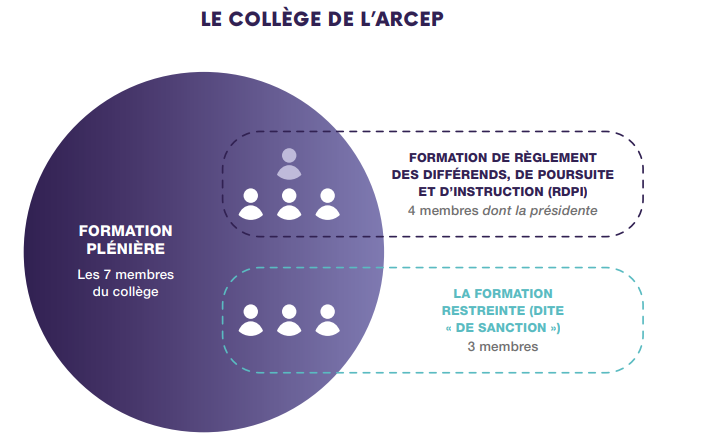
How Arcep's board works
Arcep's various powers are exercised within three separate panels of its board:
• The plenary panel, which brings together all seven members of the board. It deliberates on all decisions and opinions, except for decisions for which the law expressly provides that one of the other panels of the Authority is competent;
• The dispute resolution, prosecution and investigation panel (known as ‘RDPI’), composed of four of the seven members of the college (including the chair), which is responsible for initiating preliminary investigations, issuing formal notices, notifying complaints and ruling on disputes;
• The restricted panel (known as the ‘sanctions panel’), composed of the three other members of the college, responsible for imposing (or not) a sanction.
Associated document
[1] Decision No.2025-1145-RDPI of the Regulatory Authority for electronic communications, postal affairs and press distribution, dated 12 June 2025 ruling on a request for interim measures, submitted by the firm Hub One as part of a dispute with the urban property association Paris Nord 2
[2] CPCE Article L. 34-8-2-1, transposing directive No. 2014/61/EU
[3] Article L. 34-8-2-2, also transposing directive No. 2014/61/EU
[4] In application of CPCE Article L.34-8-2-1