
Users’ satisfaction with the sectors regulated by Arcep is one of the guiding forces behind the actions taken by the Authority. Every year, Arcep delivers an accounting of these satisfaction levels, along with the main sources of user dissatisfaction and the actions being taken as a result, by presenting:
- the findings of its annual observatory of customer satisfaction with internet service providers (ISPs) and mobile operators, based on a survey of 5,250 consumers;
- and the main takeaways from the reports received over the course of 2025 via the “J’alerte l’Arcep” site: an online platform that gives users the ability to report any malfunctions they encounter to Arcep.
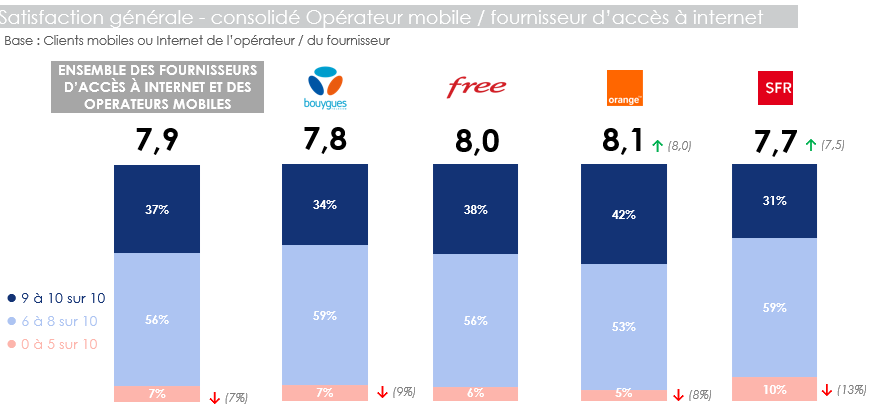
Overall customer satisfaction increases to an average of 7.9/10
The 2026 edition of the Customer satisfaction observatory is based on a survey conducted by Institut CSA in autumn 2025. Users’ satisfaction increased by 0.1 point, with an average score of 8/10 for mobile network services, and an average 7.9/10 for fixed network services.
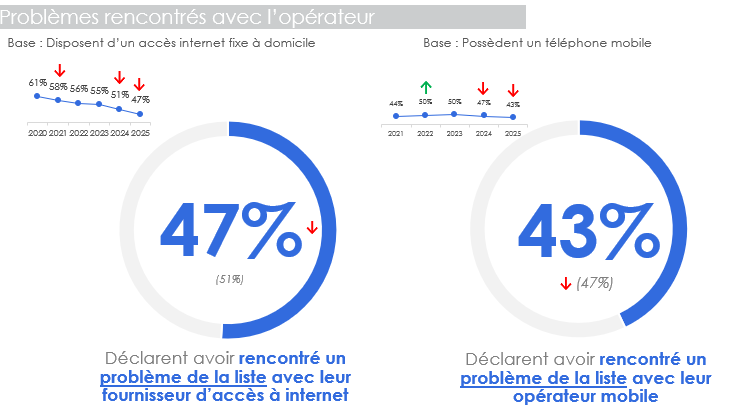
The percentage of users who have experienced at least one problem has decreased overall over the past three years
The percentage of consumers who have encountered an issue decreased:
- by 4 points in 2025 and by 8 points over two years amongst those with a fixed internet connection;
- by 4 points in 2025 and by 7 points over two years amongst those who own a mobile phone.
As revealed in the “J’Alerte l’Arcep” statistical summary, “quality of service” and “spam or scam calls” are the two main issues encountered by the people surveyed.
Spam and scam calls and text messages: a fast-growing irritant for mobile users, the impetus for a change to the numbering plan, and for the launch of a subsequent enquiry by Arcep
In the 2026 edition of the Customer satisfaction observatory, 43% of consumers report having been victims of number spoofing at least once during the previous three months.
The number of consumer reports of spam and scam calls, or of number spoofing, received on the “J’alerte l’Arcep” platform has skyrocketed: rising by 113% between 2024 and 2025.
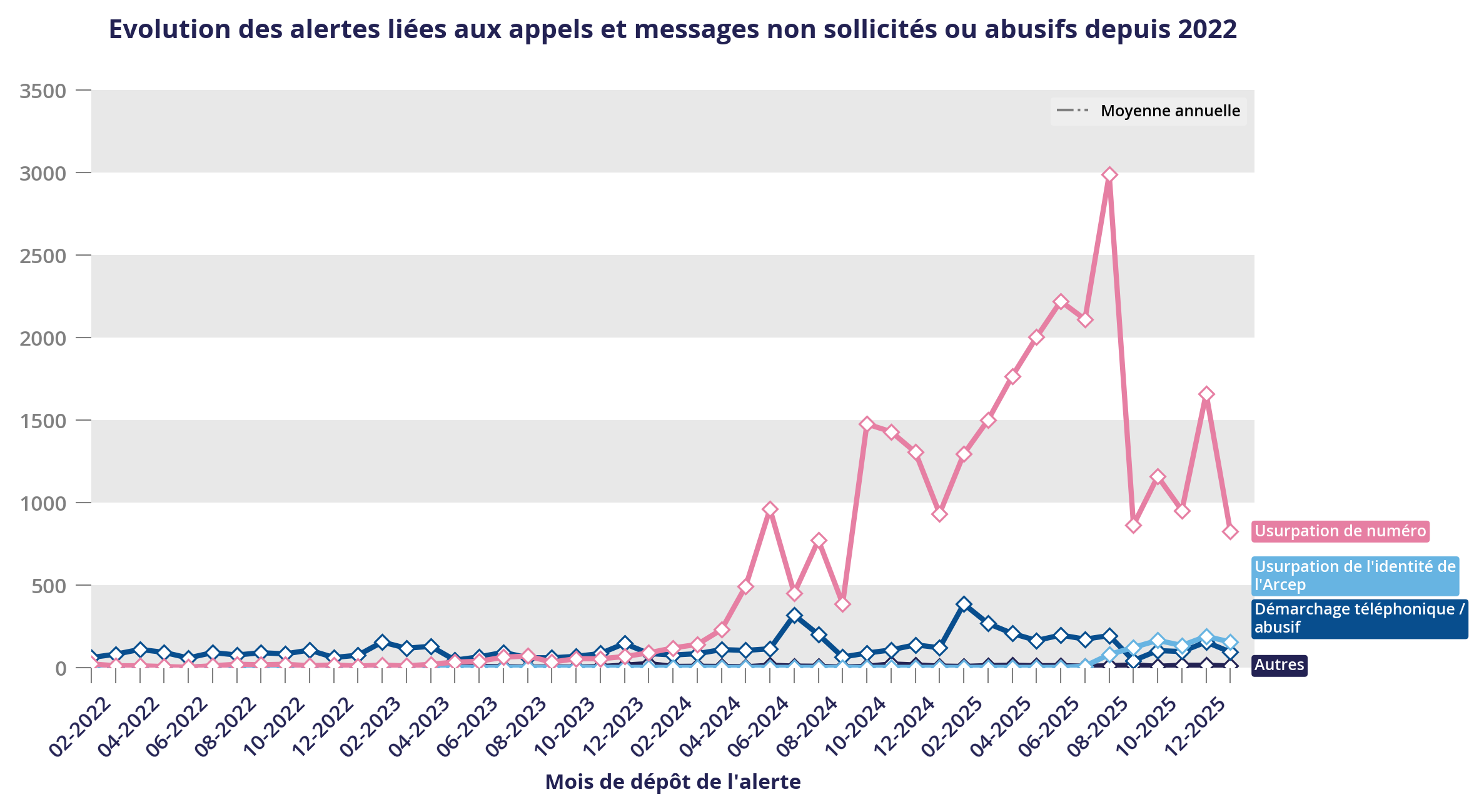
It was in this context that Arcep a adopted a change to the national numbering plan on 27 November 2025, then opened an administrative enquiry on 29 January of this year into every electronic communications operator that assigns telephone numbers from the national numbering plan.
The change to the numbering plan supplements the general obligation imposed on national operators to interrupt the routing of any calls whose number cannot be authenticated, and requires national operators to mask the caller ID of incoming international calls displaying a French mobile phone number that could not be authenticated.
The purpose of the enquiry is to understand the origin and call routing methods used by spoofed numbers, and to verify compliance with obligations to authenticate caller ID numbers, as required by Law.
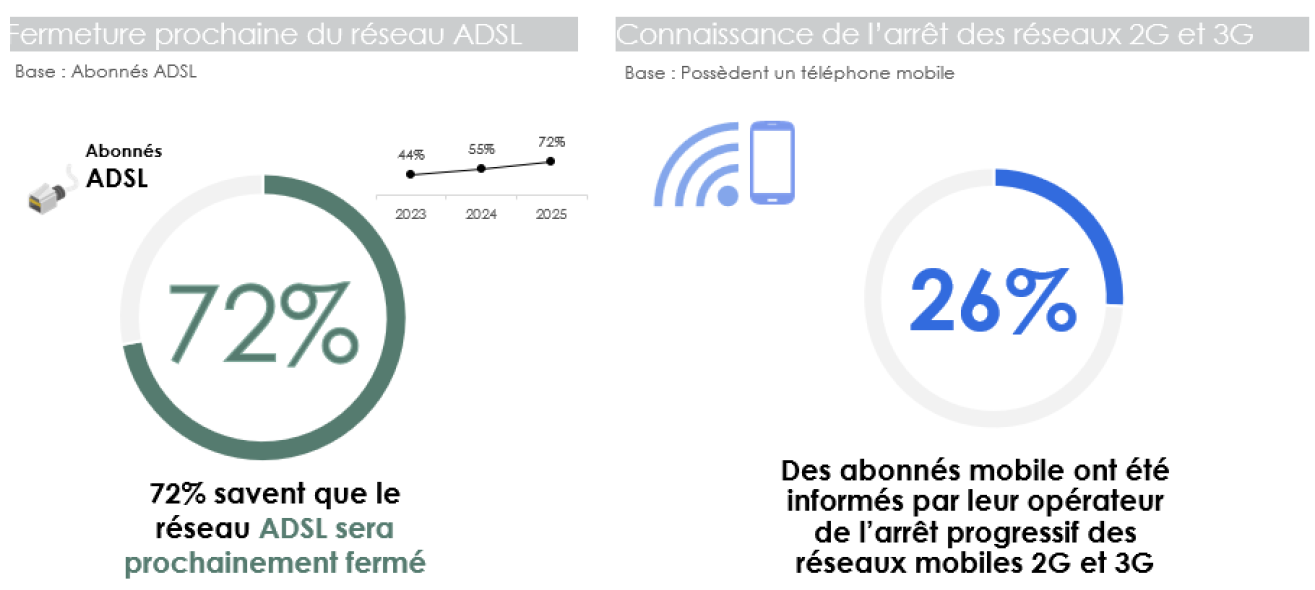
28% of ADSL subscribers are still not aware that the legacy copper network is scheduled to be decommissioned by 2030
Regarding the copper network switchoff, 72% of ADSL subscribers are aware of the upcoming decommissioning of the legacy copper network: despite a regular increase in the number of informed subscribers over the past three years, 28% are still not aware of it. In late January, Arcep sent out a complete press kit on the upcoming stages, and its role in supporting Orange in the switch off of the copper network. An FAQ on the topic is available on the Arcep website.
The Observatory nevertheless confirms a clear interest amongst ADSL customers to switch to fibre: of the “copper” subscribers surveyed who either do not have or do not know whether they have access to fibre, 93% (up 9 points from 2024) said they would switch to fibre if it were available.
This year, consumers were also queried on their knowledge of the gradual shutdown of 2G and 3G mobile networks. Twenty six percent of those surveyed said their operator had informed them of the shutdown; 90% of whom said the information provided was sufficient. In its Observatory of 2G and 3G network sunsets published on 11 December of last year, Arcep reported that 2.6 million SIM cards used in devices to access voice/SMS/mobile internet services and 3 million used in devices for Machine-to-Machine (M2M) services, or around 3% of all SIM cards (excl. M2M) and 12% of M2M SIM cards inventoried by the Observatory of mobile services for Q4 2025.
“J’alerte l’Arcep”: when publishing its annual scorecard, Arcep delivers a reminder of the benefits of its reporting platform and data-driven regulation tool
Since its launch in 2017, the “J’alerte l’Arcep” reporting platform has given individuals, businesses and local authorities the ability to report any malfunctions encountered in their relationship with their fixed or mobile operator, their ISP or postal service providers. It gives users the ability to have their own experience inform market regulation, through citizen action, and gives operators an incentive to improve their services and develop their networks. At the end of the reporting process, users are also offered tip sheets tailored to their situation. The received reports enable Arcep to track the problems being encountered by users in real time, to identify recurrent malfunctions, and detect spikes in user alerts. This serves the Authority’s ultimate aim of taking more targeted, and thereby more effective, regulatory action with operators.