
In accordance with the responsibility it was assigned by the legislature to monitor digital technology’s impact on the environment in France (see inset), Arcep collects indicators from ICT industry players, and compiles that information in a publication: the annual “Achieving digital sustainability” survey, which is accompanied by an infographics-based Executive Summary. Last year, in addition to data collected from France’s four main telecoms operators, device manufacturers and data centre operators, the survey was expanded to include indicators on the production of mobile network equipment. This fifth edition has been expanded further still to include a new category of hardware: fibre-optic cables.
Despite becoming more efficient, data centres’ energy consumption and greenhouse gas emissions continue to rise
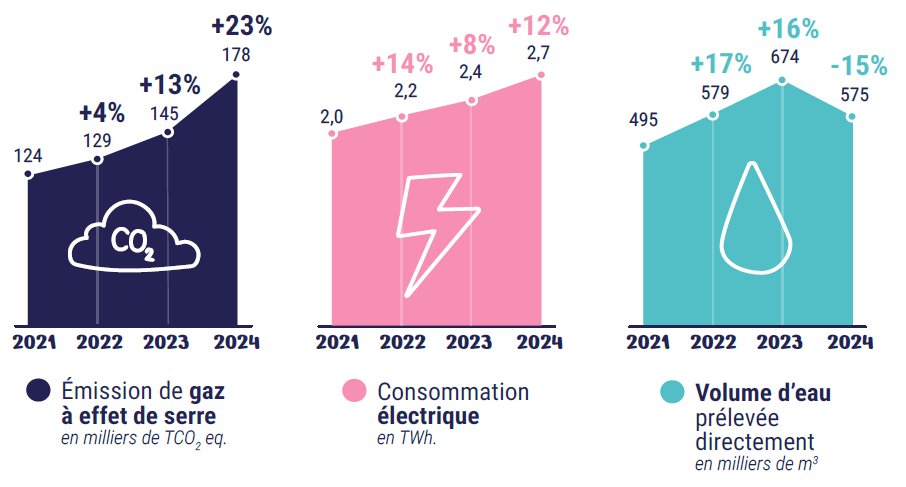
In 2024, despite there being an only small number of new installations, the total computer capacity of examined data centres has continued to surge. This increase reflects a steady scaling up of new data centres’ computing capacity. While the centres that were open in 2023 already had an average capacity of 9 MW per centre, compared to 3 MW for existing centres, those put into service in 2024 have by now reached an average capacity of 20 MW.
From a geographical standpoint, data centres’ activity is highly concentrated. In 2024, 90% of the computing power and energy consumption of the examined data centres were concentrated in the Hauts-de-France, Provence-Alpes-Côte d’Azur and Ile-de-France regions. The latter singlehandedly accounts for 56% of the centres assessed, and represents more than 70% of the of the combined computing power and energy consumption of the data centres that were examined.
Telecom networks’ energy consumption levelled off in 2024
Telecom operators’ greenhouse gas emissions increased only slightly in 2024 (+ 1% YoY), as did total greenhouse gas emissions in France that year (-0.9% YoY). The increase in operators’ emissions is due to a rise in the emissions factors of France’s energy mix, whereas direct emissions decreased in 2024 (- 5% YoY).
Fixed and mobile networks’ energy consumption has in fact been decreasing steadily since 2017, levelling off in 2024 at 4.1 TWh. Mobile networks’ consumption grew by 4% in 2024 due to a rise in mobile usage (+1.8 Gb per SIM card in 2024) and network buildouts. This growth is nevertheless being offset by a sizeable decrease in fixed local loops’ energy consumption (-16% in 2024), stemming from the steady transition from the legacy copper network to more energy-efficient FttH systems.
Arcep is conducting an initial assessment of the environmental footprint of fibre-optic cable suppliers: cables’ embodied emissions depend heavily on the number of strands they contain
The production of the fibre-optic cables sold in France in 2024 required a total 170 GWh of, chiefly electrical, energy in France and abroad, or 26% of fixed networks’ energy consumption in France in 2024. The production of fibre-optic cables also requires water: 66,000 m3 of water were used in France and abroad to produce the cables sold in France in 2024, or 200 litres of water per kilometre of cable.
The embodied greenhouse gas emissions (which correspond to total carbon emissions across the product’s life cycle, excluding the utilisation stage) of the fibre-optic cables sold in France in 2024 totalled 108,000 tonnes of CO2 equivalent. The size of these emissions depends heavily on the composition of the cables, and especially the number of fibre-optic strands: they range from around 100 kgCO₂e/km per cable for cables with 1 to 4 strands, to 2,500 kgCO₂e/km per cable for cables with more than 288 strands.
A growing percentage of new consumer hardware being put on the market are large screen devices and, in 2024, went hand in hand with an increase in the volume of certain types of device
After two years of a decrease in the volume of new devices put on the market in France, all types of hardware combined, 2024 saw an upswing the number of new releases of tablets, mobile phones and computer displays, whereas the release of new models of laptops and televisions continues to shrink, albeit at a slower pace than before.
This upswing in products being put on the market has also meant an increase in the environmental impact of digital equipment, further amplified by the ongoing increase in screen sizes for all of these devices, with the exception of laptop computers. This increase is especially pronounced with tablets and mobile phones. The larger the screen, the larger the device’s environmental footprint during the utilisation phase: on average, a big screen TV consumes six times more power than a smaller model, while a large screen computer consumes an average three times more power than a smaller model. Added to which, all types of screen combined, the average energy consumed by televisions varies, in part, according to the display technology: televisions powered by emitting technologies (OLED, microLED) consume an average of 25% more power than those with LCD/LED or similar (QLED, QNED) technologies.
The next edition of the annual “Achieving digital sustainability” survey will be expanded to include new indicators and data collected from cloud service providers
As part of its commitment to steadily enhance the data collected to measure digital technologies’ impact on the environment, in 2026 Arcep will collect new indicators from the stakeholders who are already involved, and will expand the exercise to include cloud computing service providers, in accordance with its Decision on data collection dated December 2025 (see the press release).
Data collection powers assigned to Arcep by Parliament
In 2021, the Law on strengthening Arcep’s environmental regulation of the digital sector (REEN Act), entrusted the Authority with the task of designing an environmental barometer, and gave it the power to collect environmental data, not only from electronic communication service providers, but also from providers of public online communication services, data centre operators, device manufacturers, network equipment suppliers and operating system providers. It also expanded Arcep’s data collection powers to include cloud computing providers.
Annual “Achieving digital sustainability” survey: a tool to inform public debate and discussions over a low-carbon strategy for digital technology
There are four main objectives attached to Arcep’s annual “Achieving digital sustainability” survey:
- Inform citizens, public sector players and all of the stakeholders on the digital technology sector’s environmental footprint;
- Identify economic players’ activities that are likely to have an impact on the environment;
- Encourage stakeholders to take steps to achieve the most efficient measurement possible of their environmental footprint;
- Monitor the progression of these indicators over time, creating the ability to assess the impact of environmental protection actions put in place by businesses, and to supply relevant information for evaluating public policies on digital and the environment, and particularly the Authority’s actions in this area.
Associated documents
Executive Summary in infographics (pdf - 1.45 MB) (English version available)