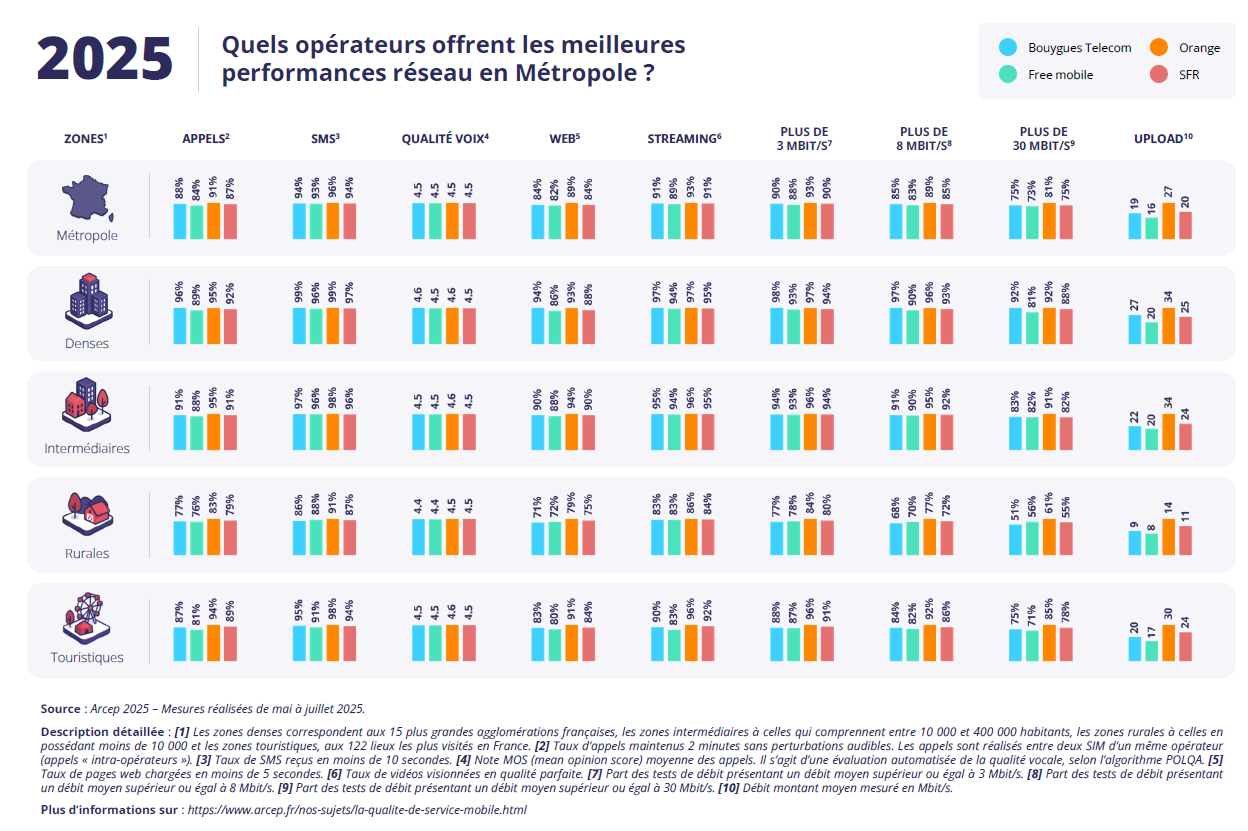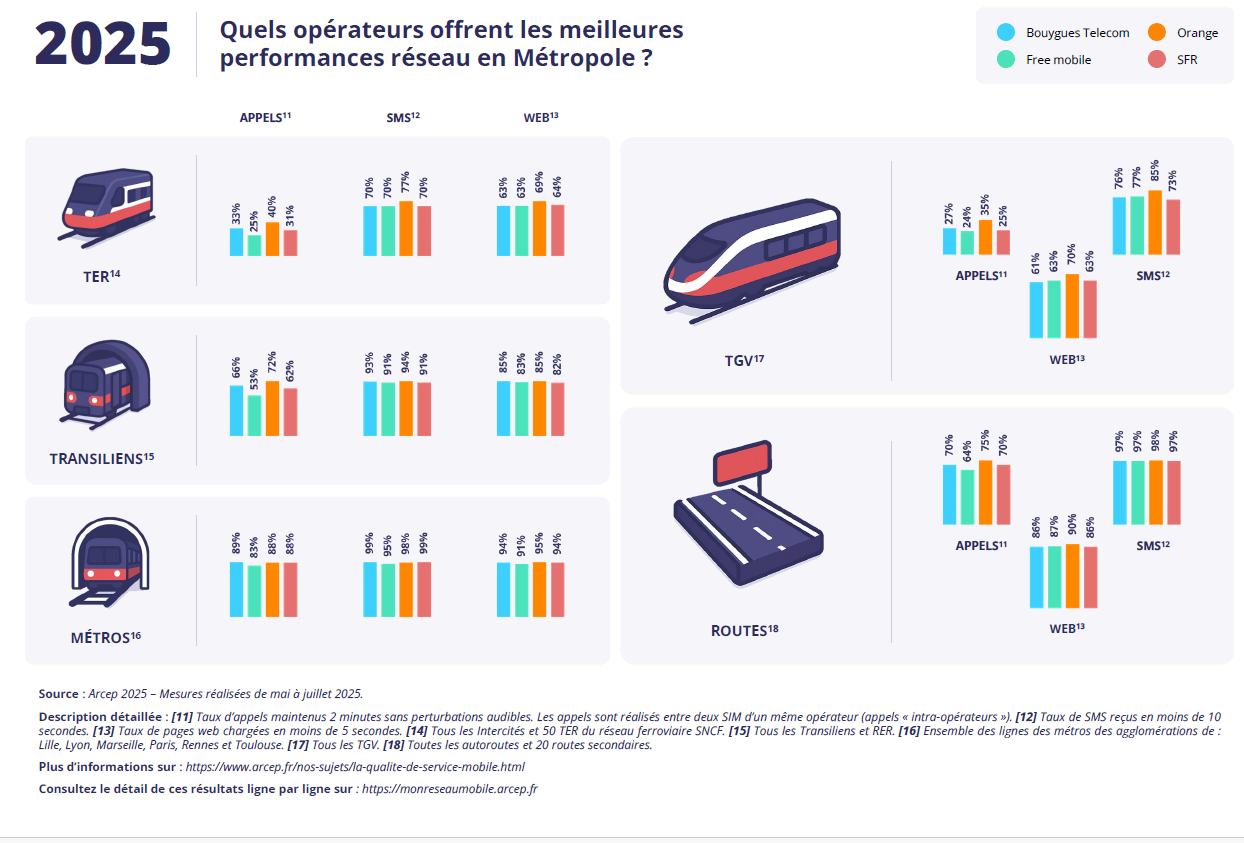
Today Arcep is publishing the results of its 2025 annual audit assessing the quality of the services provided by mobile operators in Metropolitan France. Based on more than a million measurements taken in every department of Metropolitan France, between June and August 2025, the mobile QoS audit assesses the quality of voice, SMS, and mobile internet services in all living environments (indoors and outdoors), and on various forms of transportation (roads, metros and trains).
For this edition, a second OTT[1] voice platform was included, to obtain more representative results.
For more detailed information by operator and by zone, Arcep invites readers to compare, based on the type of area (high density, medium density or rural) where they live, and the types of transport corridor they use.
VOICE AND TEXTING QoS: HIGH QUALITY NATIONWIDE CONFIRMED
The results confirm good quality calling nationwide, even if the quality of calls for all operators is significantly lower in rural areas
These results factor in the statistical accuracy of the margin of error for each estimate. This means that, if the gap between operators remains within that margin, they are considered to be tied.
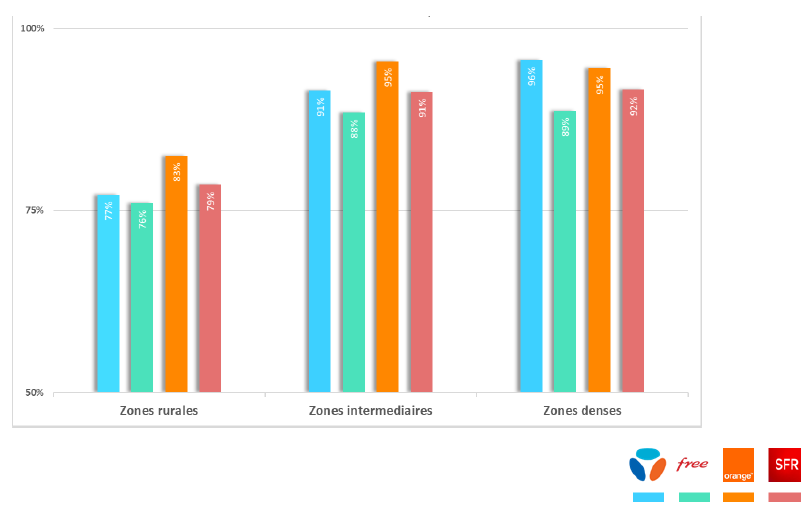
Perfect quality calls (i.e. the success rate for maintaining a two-minute call without audible interference):
At the national level, 91% of calls are considered to be of perfect quality for Orange, ahead of Bouygues Telecom (88%) and SFR (87%) which are tied, with Free Mobile in last place at 84%.
In high-density areas, Bouygues Telecom (96%) and Orange (95%) are tied for first, ahead of SFR (92%) followed by Free Mobile (89%).
In medium-density areas, Orange (95%) is ahead of Bouygues Telecom and SFR which are tied at 91%, followed by Free Mobile, scoring 88% for perfect quality calls.
In rural areas, 83% of calls are considered to be of perfect quality for Orange, followed by SFR (79%), Bouygues Telecom (77%) and Free Mobile (76%) which are considered tied.
Regarding the success rate for calls (completed and maintained for two-minutes): Orange leads at the national level with 95%, ahead of the other operators.
SMS QoS: Texts delivered rapidly
The success rate for receiving an SMS in under 10 seconds is very high for all four operators: 96% for Orange ahead, followed by Bouygues Telecom (94%), SFR and Free Mobile (93%) which are all tied.
OTT VOICE: EXPANDED AUDIT
For the second consecutive year, Arcep’s mobile quality of service audit includes QoS indicators for voice calls made using an instant messaging (OTT calling) application. In 2025, a second application was added to obtain more representative results.
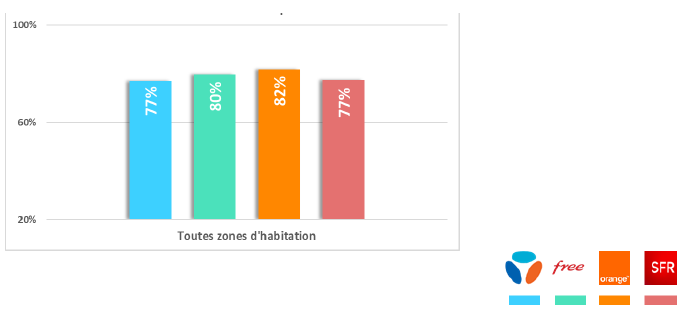
The quality of OTT voice calls (the success rate for maintaining a two-minute call without audible interference) varies depending on the operator: Orange (82%) is tied with Free Mobile (80%), while SFR and Bouygues Telecom have a success rate of 77%. On average, these results for OTT calling are below those obtained by operators’ own voice service.
N.B.:
The volume of testing was adjusted proportionate to these practices, which are still a minority;
Two of the most popular platforms were tested;
The performance of these voice services can vary depending on the version, and on each devices’ settings.
MOBILE INTERNET: PERFORMANCES ALIGNED WITH DIGITAL PRACTICES
The download speed indicator that Arcep uses includes three thresholds: 3, 8 and 30 Mbit/s, which correspond to different requirement levels depending on the application. These thresholds were chosen to translate the representative quality of experience for the main digital services employed on a daily basis:
3 Mbit/s: speed suited to the least demanding mobile internet uses, such as web browsing;
8 Mbit/s: speed suited to the most widespread uses, such as video streaming;
30 Mbit/s: speed suited to the most demanding uses, such as collaborative or business tools.
This approach makes it possible to assess performance in a balanced fashion, without creating an incentive for operators to engage in a “speed race”, but rather to be part of the drive initiated by Arcep to achieve digital sustainability.
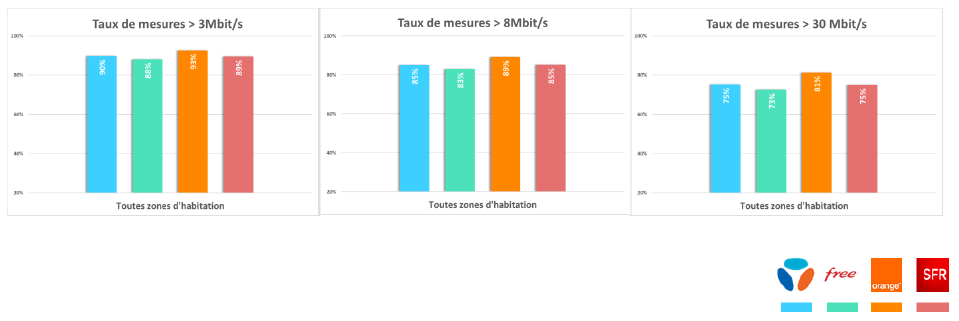
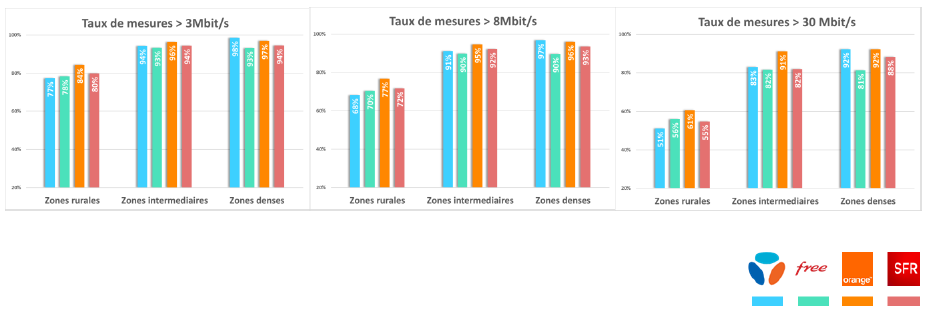
In high-density areas, Bouygues Telecom is ahead of the other operators for the minimum threshold of 3 Mbit/s, and is tied with Orange for the most demanding thresholds of 8 and 30 Mbit/s.
In medium-density and rural areas, Orange is ahead of the other operators for the 3, 8 and 30 Mbit/s thresholds.
The tests performed also covered upstream speeds, which are becoming increasingly important with the development of artificial intelligence and collaborative applications. They influence the speed at which data, images and content are sent to the cloud and to real-time analytics platforms.
In high-density areas, average upstream speeds for Orange stand at 34 Mbit/s, putting it ahead of Bouygues Telecom (27 Mbit/s) and SFR (25 Mbit/s), which are tied, then Free Mobile (20 Mbit/s). In rural areas, average upstream speeds for Orange stand at 14 Mbit/s, which is followed by SFR (11 Mbit/s) then Bouygues Telecom (9 Mbit/s), which is tied with Free Mobile (8 Mbit/s).
WEB BROWSING AND VIDEO STREAMING: A SMOOTH EXPERIENCE IN MOST CASES
High quality of experience ascertained for web browsing and video streaming, especially in high and medium-density areas
The most common uses of the mobile internet tested in summer 2025[2], such as web browsing and video streaming, confirmed that performance levels are high, particularly in high and medium-density areas where all four operators provide a smooth user experience.
Regarding web browsing, most web pages are loaded in under 5 seconds: Bouygues Telecom (94%) and Orange (93%) are tied, ahead of SFR (88%) then Free Mobile (86%) in high-density areas. The rankings differ in rural areas: Orange (79%) is ahead of SFR (75%), followed by Free Mobile (72%) and Bouygues Telecom (71%) which are tied for third place.
All four operators perform well on video streaming. In high-density areas, QoS is virtually perfect, with a success rate of 97% for videos streamed without a noticeable interruption, for Orange and Bouygues Telecom, which are tied and which outperform SFR (95%) and Free Mobile (94%).
QOS ALONG TRANSPORT CORRIDORS: KEY FINDINGS
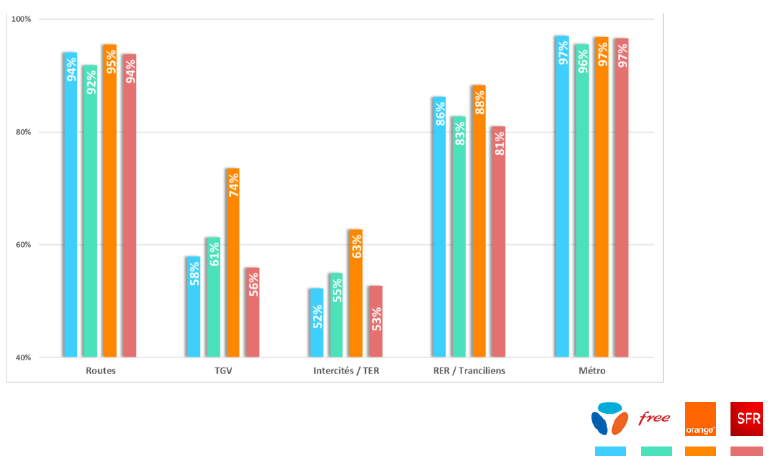
Quality of service remains high on roads and on metro lines, while results are more mixed on RER and Transilien commuter lines, and considerably lower on TGV (high-speed rail), Intercités and TER regional lines.
Call quality (success rate for calls completed and maintained for two minutes):
- For calls made while on roadways, Orange (with a 95% success rate) scored higher than Bouygues Telecom and SFR (94%), as well as Free Mobile (92%).
- Results for calling on trains are more disparate, particularly on TGV high-speed trains where Orange leads the way with a 74% success rate for calls maintained for two minutes, followed by Free Mobile (61%), Bouygues Telecom (58%) and SFR (56%), which are tied.
- On Intercités and TER trains, Orange has a 63% success rate, ahead of Free Mobile (55%), SFR (53%) and Bouygues Telecom (52%), which are all tied.
- On RER and Transiliens commuter lines, Orange has an 88% success rate for calls completed and maintained for two minutes, tied with Bouygues Telecom at 86%, and ahead of Free Mobile (83%) and SFR (81%), which are also tied.
- Performance levels on metro lines are very good overall, with Bouygues Telecom, SFR and Orange reaching a 97% success rate, and tied with Free Mobile at 96%.
Internet quality of service:
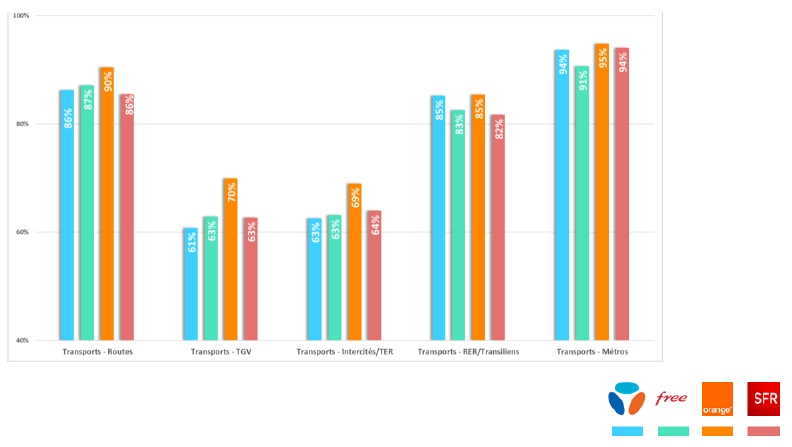
On average, all operators combined, internet quality of service is very high on roads, with a close to 87% success rate for web pages loaded in under five seconds.
The situation is far more nuanced on railway lines: a web page can be loaded in under five seconds in only 64% of cases on TGV high-speed trains, and 65% on Intercités and TER (regional express) lines. Browsing is more fluid on RER and Transiliens commuter trains in the Paris region (84%) and on metro lines (93%).
Results on web browsing quality tests (web page loaded in under 5 seconds) are as follows:
On roads, Free Mobile (87%) is ahead of Bouygues Telecom then SFR (86%), all three of which are outperformed by Orange with a 90% success rate.
On long distance, TGV high-speed railway lines, Orange stands out again, with 70% of pages loaded in under 5 seconds, compared to 63% for Free Mobile and SFR, which are tied, followed by Bouygues Telecom with 61%.
On the Intercités and TER regional express networks, Orange has a success rate of 69%, followed by the other three operators.
On RER and Transiliens commuter lines, Orange and Bouygues Telecom (85%) are tied, performing better than Free Mobile (83%) and SFR (82%), which are also tied.
On metro lines, all four operators perform very strongly: Orange stands at 95%, ahead of SFR and Bouygues Telecom which are tied at 94%, then Free Mobile at 91%.
All the findings are available as open data
Arcep makes all the measurements obtained during this audit available as open datasets on both its own website and on data.gouv.fr. These findings will also be available shortly on the “Mon réseau mobile” tool.
Annexes:
Annex 1: Scope of enquiry in 2025
Annex 2: Summary of 2025 findings
Links:
Map-based visualisation tool: monreseaumobile.arcep.fr
Open datasets: https://www.data.gouv.fr/fr/datasets/monreseaumobile
[1] Over the top (OTT) application providing a service (calling, streaming, messaging, etc.) over the internet, without going through an ISP’s classic services.
[2] The audit was carried out during summer 2025, which was marked by multiple heatwaves. These conditions can have a temporary effect on how devices perform, albeit without altering the representativeness of the findings, which reflect the use of mobile networks under real-life conditions across the country.
Annex 1: Methodology and scope of the mobile QoS audit
Mobile QoS audit based on a more than a million measurements taken in 2G, 3G, 4G and 5G
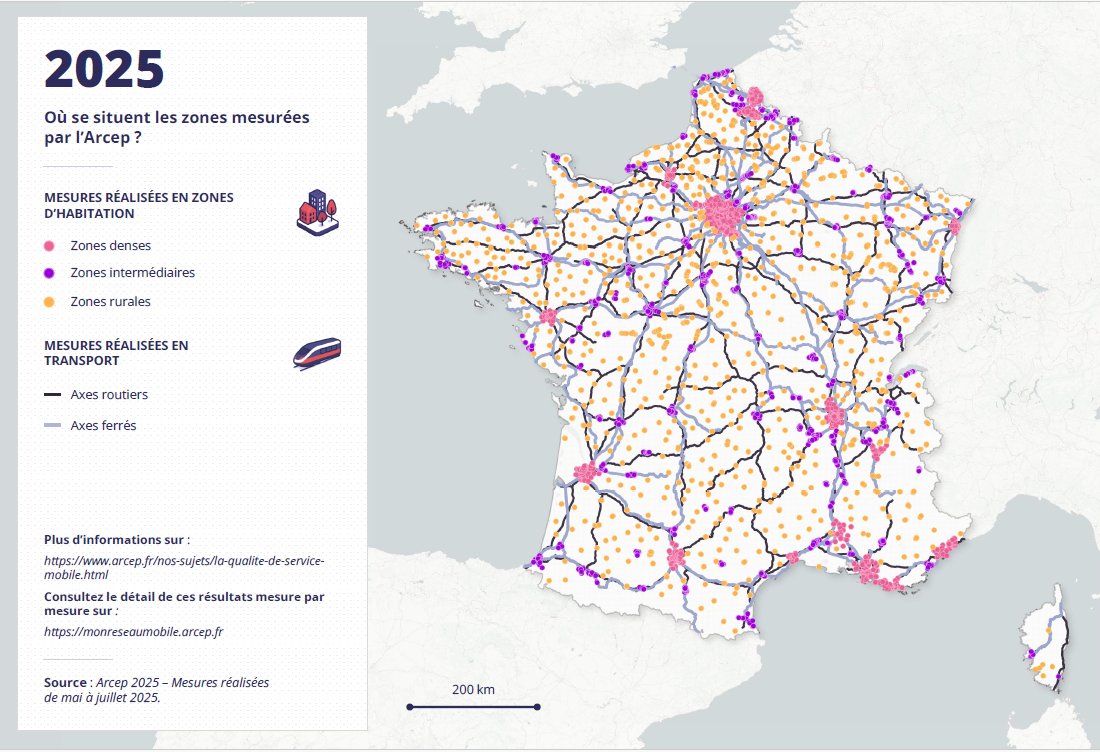
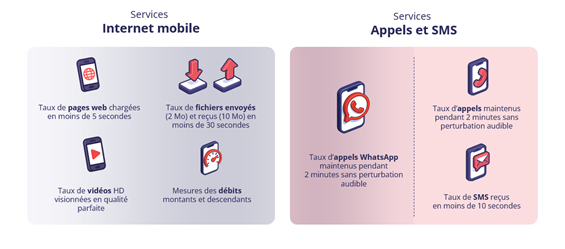
More than one million measurements in a chain of 2G, 3G, 4G and 5G-compatible links were carried out in every department across Metropolitan France, between end of May and August 2025, in residential locations, indoors and outdoors, and on various forms of transportation (the number of tests conducted on TGV high-speed trains was increased to reflect real-world connectivity conditions on long-distance trains). The mobile QoS audit covered the most widely used mobile services: web browsing, video streaming, data transfer, texting, and voice calls (notably OTT calls). The tests that were performed sought to evaluate the performance of operators’ networks in a strictly comparable fashion, and this under a wide range of conditions. Note that the measured performances are averages, and in no way prejudice the user experience in the moment. The quality of voice, texting and mobile internet services can vary due to the load on the network at any given time, and the conditions under which a service is being used.
Mobile internet | Calls and texting |
|---|---|
|
|