
Today Arcep is publishing the results of its 2026 mobile quality-of-service (QoS) audits of the Antilles and Guiana. These publications give consumers in France’s overseas departments and territories the ability to compare local operators’ performance, and for local decision-makers to obtain an assessment of mobile connectivity in their territory. All of the data are available on the “Mon réseau mobile” (My mobile network) website and as open datasets. The results of the audit carried out in Réunion and Mayotte will be the subject of a future publication.
More than 465,000 mobile quality of service tests performed in Guadeloupe, Martinique, Guiana, in Saint Barthélemy and Saint Martin.
The purpose of the tests carried out between May and July 2026 was to assess the performance of overseas operators’ networks in an entirely comparable manner, and under a variety of conditions. The audit therefore covered the following mobile services:
Voice and SMS: the success rate for calls maintained for two minutes and without audible interference, voice quality (MOS1), SMS received in under 10 seconds;
Internet and mobile use: average speeds (upstream and downstream), web browsing (pages loaded in 5 and 10 seconds), decent and perfect quality video streaming.
The 2026 campaign expanded 5G testing to include Guadeloupe and Martinique and continued to assess OTT voice services
For the first time, 5G-compatible measurement chains were used for all tests, and 5G measurements were conducted for the first time in Guadeloupe and Martinique. The devices had an open 2G/3G/4G/5G2 access setting, to enable 5G testing on those operators that have deployed the technology: OMT and Orange in Guadeloupe, in Martinique and in Guiana, as well as Dauphin Télécom and Orange in Saint Martin and Orange in Saint Barthélemy.
5G networks had already been tested in 2025 in Guiana, Saint Martin and Saint Barthélemy.
In addition, the voice quality of calls made using an instant messaging application (OTT voice)3 was tested once again in 2026, on 10% of the samples. These results supplement the assessment of the audit classic voice QoS.
The findings are to be assessed on a territory-by-territory and operator-by-operator basis, for each type of mobile application. Arcep also invites everyone to visit the “Mon réseau mobile” website to view the complete findings, by territory, of which a preview can be found in the annex to this media release:
In Guadeloupe: Orange and Outremer Telecom (OMT) are tied4 for first place on multiple internet, mobile and voice indicators in residential locations. Regarding roadways, the two operators are tied for first on calls maintained for two minutes without audible interference, while Orange ranks first on web pages loaded in under 5 seconds.
In Martinique: Every operator provides an overall good voice quality during calls maintained for two minutes without audible interference, in residential locations. Orange and OMT are neck and neck on voice service QoS. For internet and mobile services, Orange has the strongest score on web pages loaded in under 5 seconds, followed by Digicel and OMT which are tied for second.
In Guiana: Orange and OMT top the ranks on most indicators in residential locations, notably voice quality (MOS), where they are tied for first, ahead of Digicel and Free Caraïbe. Regarding internet and mobile services, Orange has the strongest performance on most indictors, notably web pages loaded in under 5 and 10 seconds in residential locations, and on the 3 Mbit/s download speed threshold, whereas Outremer Télécom scores highest on upload speeds.
Saint Martin: Digicel and Free Caraïbe are tied for second on MOS behind Orange, which scores highest on voice quality indicators. Dauphin Télécom is tied for first with Orange on web pages loaded in under 5 seconds, while Orange ranks number one on upload and download speeds, and this for all tiers. UTS is tied for first with Orange on perfect quality video streaming.
Saint Barthélemy: Orange delivers the strongest performance overall, both on voice/SMS and data services. Digicel is tied for first with Orange on calls maintained for two minutes without audible interference. Dauphin Télécom shares top spot with Orange on 3 and 8 Mbit/s download speed thresholds.
A note about Outremer Télécom VoLTE services
In early 2026, operator Outremer Télécom began deploying Voice over LTE (VoLTE) services for making voice calls using 4G technology5. In the first half of the year, this rollout covered only customers who subscribe to certain “RED by SFR Caraïbe” plans, including the one Arcep employs to carry out its tests. This meant that, at the time of that testing, VoLTE was available to only a portion of Outremer Télécom customers, i.e. “RED by SFR Caraïbe” subscribers with a compatible device.
Detailed indicators are provided below, for each territory.
Verification of the new enhanced 4G coverage maps
Arcep’s QoS audit in the overseas territories also includes a portion dedicated to verifying the accuracy of operators’ coverage maps: created based on digital simulations, these maps cover voice, SMS, internet and mobile services. For the first time, Arcep verified the accuracy of these new internet and 4G mobile maps that overseas operators have been providing since late 2025 (see the press release), ensuring they comply with a high level of accuracy for each territory. The results of this accuracy audit led operators to correct certain local information.
Associated documents:
- Audit results on “Mon Réseau Mobile”
- Data available as open datasets on data.gouv.fr
ANNEX – Detailed results by territory (residential locations)
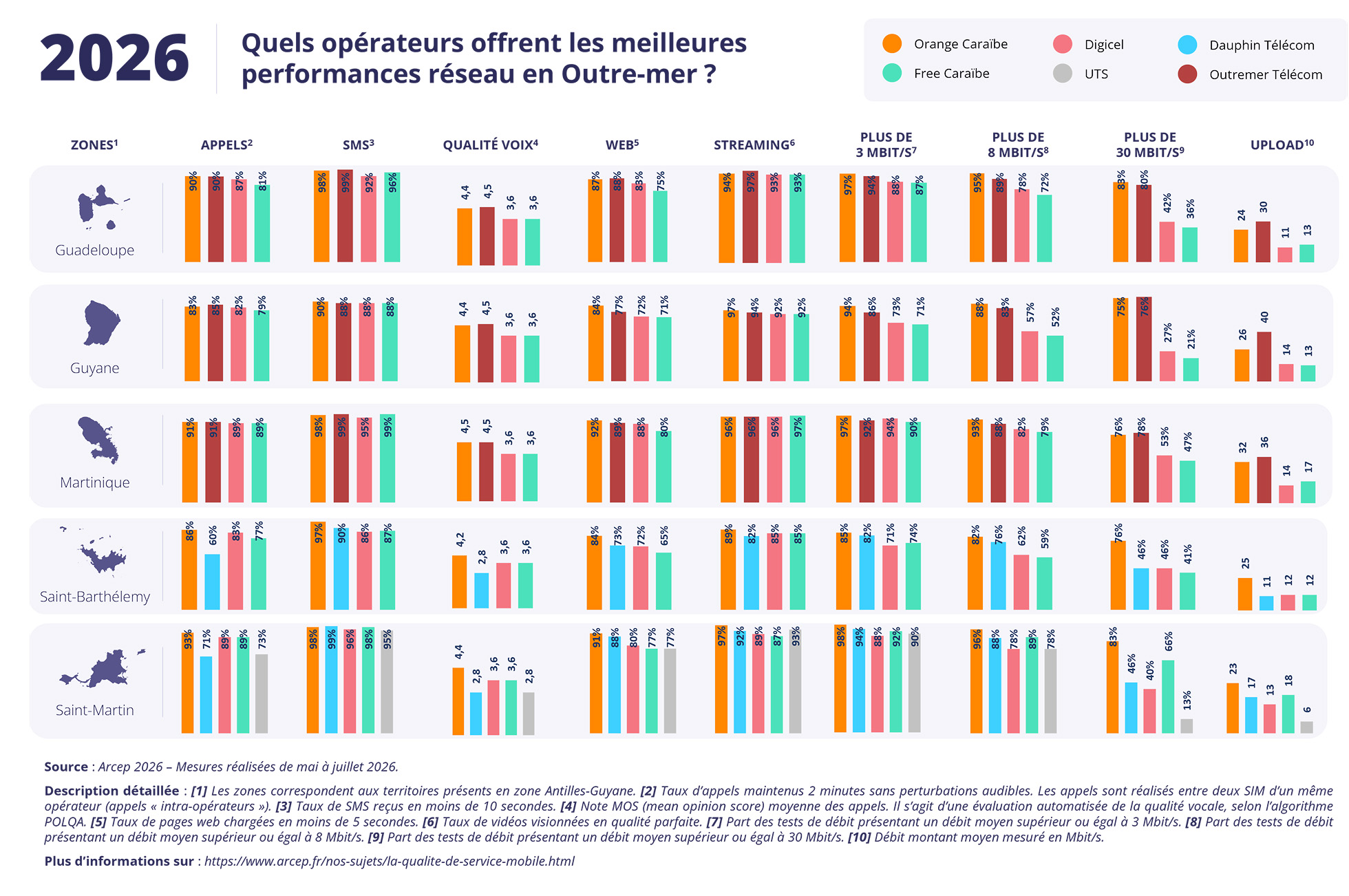
Source: Arcep 2026 – tests carried out from May to July 2026
Detailed description: [1] The areas correspond to territories in the Antilles-Guiana region. [2] Percentage of calls maintained for 2 minutes without audible interference. Calls are made between two SIM cards from the same operator (‘intra-operator’ calls). [3] Percentage of text messages received in under 10 seconds. [4] Average MOS (mean opinion score) for calls. This is an automated assessment of voice quality, based on the POLQA algorithm. [5] Percentage of web pages loaded in under 5 seconds. [6] Percentage of videos viewed in perfect quality. [7] Percentage of speed tests with an average speed greater than or equal to 3 Mbit/s. [8] Percentage of speed tests with an average speed greater than or equal to 8 Mbit/s. [9] Percentage of speed tests with an average speed greater than or equal to 30 Mbit/s. [10] Average upload speed measured in Mbit/s.
For more information, visit: https://www.arcep.fr/nos-sujets/la-qualite-de-service-mobile.html
ANNEX - Detailed results by territory (Roadways)

Spotlight on roadways
These indicators are the results of QoS tests conducted on roads across French overseas territories.
Source: Arcep 2026 – Testing conducted from May to July 2026
Detailed description: [11] Success rate for calls maintained for two minutes and of calls maintained for two minutes without audible disturbance. Calls are made between two SIM cards belonging to the same operator (on-n and calls).[ 12] Success rate of SMS received in under 10 seconds. [13] Success rate of web pages loaded in under in under 5 seconds. [14]MOS (mean opinion score) for calls. This in an automated assessment of voice quality, using the POLQA algorithm.
- For more information, visit: https://www.arcep.fr/nos-sujets/la-qualite-de-service-mobile.html
- View detailed, line by line results at: https://monreseaumobile.arcep.fr/
Source : Arcep 2026 – Tests carried out between May and July 2026.
Detailed description: The areas correspond to territories in the Antilles-Guiana region. [2] Percentage of calls maintained for 2 minutes without audible interference. Calls are made between two SIM cards from the same operator (‘intra-operator’ calls). [3] Percentage of text messages received in under 10 seconds. [4] Average MOS (mean opinion score) for calls. This is an automated assessment of voice quality, based on the POLQA algorithm. [5] Percentage of web pages loaded in under 5 seconds. [6] Percentage of videos viewed in perfect quality. [7] Percentage of speed tests with an average speed greater than or equal to 3 Mbit/s. [8] Percentage of speed tests with an average speed greater than or equal to 8 Mbit/s. [9] Percentage of speed tests with an average speed greater than or equal to 30 Mbit/s. [10] Average upload speed measured in Mbit/s.[11] Percentage of calls maintained for 2 minutes without audible interference. Calls are made between two SIM cards from the same operator (‘intra-operator’ calls). [12] Percentage of text messages received in under 10 seconds. [13] Percentage of web pages loaded in under 5 seconds.
N.B.: the download speed indicator used by Arcep includes three thresholds – 3, 8 and 30 Mbit/s – corresponding to different levels of requirement depending on usage:
• 3 Mbit/s: speed suitable for the least demanding mobile Intern and uses, such as web browsing;
• 8 Mbit/s: speed suitable for the most common uses, such as watching videos;
• 30 Mbit/s: speed suitable for the most demanding uses, such as using collaborative tools in the workplace.
The different mobile service quality thresholds reflect the user experience and are broken down by type of area (dense, intermediate, rural). This approach also has the benefit of not creating an incentive for operators to compete for maximum speed, and is in line with the ‘For a sustainable digital world’ initiative launched by Arcep.
- For more information:: https://www.arcep.fr/nos-sujets/la-qualite-de-service-mobile.html
- For detailed information on these results, line by line: https://monreseaumobile.arcep.fr
1 The mean opinion score (MOS) for maintained calls, which measures the different between the live call and the baseline sample.
2 Open access mode means that the device was not confined to any single or set of specific technologies (e.g.: 2G/3G/4G) but rather capable of switching between the different technologies used to access a given service.
3 Over the top – OTT: application providing a service (calling, streaming, messaging, etc.) over the internet, without going through an ISP’s classic services.
4 These results factor in the statistical accuracy of the margin of error for each estimate. This means that, if the gap between operators remains within that margin, they are considered as being tied. In this instance, Orange and Outremer Telecom are considered as being tied. It should be noted that this statistical accuracy can vary from one indicator to the next, depending on the volume of testing.
5 VoLTE (or Voice over LTE) creates the ability to make and receive calls over a 4G network, instead of having to switch to 2G or 3G.